The efficiency of microorganisms
In this project we will show one of the problems encountered during a
trip to space.
We will use the data collected by NASA itself and other researchers to
expose one of the risks that a human being faces when leaving their
natural habitat.
Finally, explaining scientific concepts, we will show how we can
overcome this challenge and how our "super hero" can help us in this
mission.
Information that was taken from NASA data to show the effects that a
trip to space can have on a human being.
Additional information taken from research and testing carried out by
experts.
in the explore section, we show how we
can solve this problem by showing evidence that our theory makes
sense.
Radiation
The first hazard of a human mission to Mars is also the most difficult
to visualize because, well, space radiation is invisible to the human
eye. Radiation is not only stealthy, but considered one of the most
menacing of the five hazards.
Above Earth’s natural protection, radiation exposure increases cancer
risk, damages the central nervous system, can alter cognitive function,
reduce motor function and prompt behavioral changes. To learn what can
happen above low-Earth orbit, NASA studies how radiation affects
biological samples using a ground-based research laboratory.
The space station sits just within Earth’s protective magnetic field, so
while our astronauts are exposed to ten-times higher radiation than on
Earth, it’s still a smaller dose than what deep space has in store.
To mitigate this hazard, deep space vehicles will have significant
protective shielding, dosimetry, and alerts. Research is also being
conducted in the field of medical countermeasures such as
pharmaceuticals to help defend against radiation.
ESC TO LEAVE
Radioprotection
The protection set of protection or preventive protection or personnel
protected by radiation is protected by a set of protection mechanisms of
protection or individualized protection by radiation.
Radioactive materials and their resulting radioactivity produced have
existed in outer space since the origin of the universe, starting to be
used from sex. XIX. Radiation is the propagation of energy in the form
of electromagnetic waves or particles. The electromagnetic wave, in
turn, is a form of energy constituted by electric and magnetic fields,
which vary and oscillate in planes perpendicular to each other, and
which are capable of propagating in space. In a vacuum, its propagation
speed is 300,000 km/s.
Radioactive materials and their resulting radioactivity produced have
existed in outer space since the origin of the universe, starting to be
used from sex. XIX. Radiation is the propagation of energy in the form
of electromagnetic waves or particles. The electromagnetic wave, in
turn, is a form of energy constituted by electric and magnetic fields,
which vary and oscillate in planes perpendicular to each other, and
which are capable of propagating in space. In a vacuum, its propagation
speed is 300,000 km/s.
ESC TO LEAVE
Panspermia
Planet Earth is the planet inhabited by us living beings. Also known as
a water planet, it is the largest of the four rocky planets that make
part of the Solar System. Planet Earth is known as the Blue Planet
because it has 70% of its surface covered with water. Microorganism,
bacteria, is also found on our planet and which is highly resistant to
radiation and other environmental risks.
Planet Earth is known as the Blue Planet because it has 70% of its
surface covered with water. Microorganism, bacteria, is also found on
our planet and which is highly resistant to radiation and other
environmental risks.
Extremophiles are organisms that live in environments with conditions
that are considered adverse to the most common on the planet. We tend to
think that nothing would survive the conditions they survive, ranging
from extreme temperatures and pH to high levels radiation and salinity.
Deinococcus bacteria do not exist in Earth a place radioactive enough to
deal with them. for supporting radiation doses 3,000 times greater than
humans.
ESC TO LEAVE
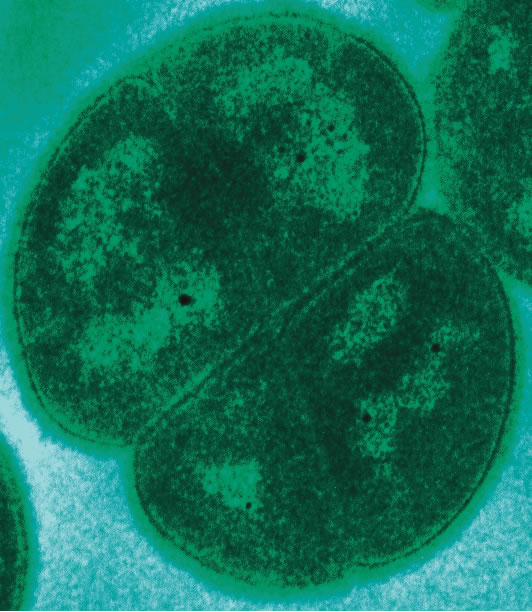
Bacteria Deinococcus
A type of bacteria that is highly resistant to radiation and other
environmental hazards has survived outside the International Space
Station for three years, according to a new study.
The Deinococcus bacterium is found on Earth and has been nicknamed
“Conan the Bacteria” by scientists for its ability to survive cold,
dehydration and acids.
It can withstand 3,000 times the amount of radiation that would kill a
human and was first isolated in meat cans subjected to sterilizing
radiation.
ESC TO LEAVE
Bacteria Deinococcus
A bacterium, known to be extraordinarily resistant, managed to survive
outside the International Space Station for a year. According to the
researchers, this ability to resist and adapt to adverse conditions
provides evidence that longer and more distant journeys are possible for
these organisms.
The results of the research, carried out by the University of Vienna,
were recently published by the journal Microbiome. They also reinforce
the belief that these microorganisms are so resistant that they can
migrate between planets and distribute life in the universe.
"These investigations help us understand the mechanisms and processes by
which life can exist outside Earth, expanding our knowledge of how to
survive and adapt in the harsh environment of outer space," said Tetyana
Milojevic, author of the study.
ESC TO LEAVE

.jpg)